Exchange Rates International Finance Copeland Pdf Printer
Posted : admin On 05.09.2019The CIIF, International Center for Financial Research, is an interdisciplinary center with an international outlook and a focus on teaching and research in finance. It was created at the beginning of 1992 to channel the financial research interests of a multidisciplinary group of professors at IESE Business School and has established itself.
- Part II EXCHANGE RATE DETERMINATION 147 5 Flexible prices: the monetary model 149 Introduction 149 5.1 The simple monetary model of a floating exchange rate 150 5.2 The simple monetary model of a fixed exchange rate 158 5.3 Interest rates in the monetary model 167 5.4 The monetary model as an explanation of the facts 169 5.5 Conclusions 173.
- International Finance - Exchange Rates. The value at which an exchange of currencies takes place is known as the exchange rate. The exchange rate can be regarded as the price of one particular currency expressed in terms of the other one, such as £1 (GBP) exchanging for US$1.50 cents. The equilibrium between supply and demand of currencies is known as the equilibrium exchange rate.
Preface and acknowledgements
1 Introduction
Introduction
1.1 What is an exchange rate?
1.2 The market for foreign currency
1.3 The balance of payments
1.4 The DIY model
1.5 Exchange rates since World War II: a brief history
1.6 Overview of the book
Summary
Reading guide
Notes
Part 1
THE INTERNATIONAL SETTING
2 Prices in the open economy: purchasing power parity
Introduction
2.1 The law of one price in the domestic economy
2.2 The law of one price in the open economy
2.3 A digression on price indices
2.4 Purchasing power parity
2.5 Purchasing power parity – the facts at a glance
2.6 Purchasing power parity extensions
2.7 Empirical research
2.8 Conclusions
Summary
Reading guide
Notes
3 Financial markets in the open economy
Introduction
3.1 Uncovered interest rate parity
3.2 Covered interest rate parity
3.3 Borrowing and lending
3.4 Covered interest rate parity – the facts
3.5 Efficient markets – a first encounter
3.6 The carry trade paradox
3.7 Purchasing power parity revisited
Summary
Reading guide
Notes
4 Open economy macroeconomics
Introduction
4.1 IS–LM model of aggregate demand
4.2 Aggregate supply
4.3 Conclusions
Summary
Reading guide
Notes
Part 2
EXCHANGE RATE DETERMINATION
5 Flexible prices: the monetary model
Introduction
5.1 The simple monetary model of a floating exchange rate
5.2 The simple monetary model of a fixed exchange rate
5.3 Interest rates in the monetary model
5.4 The monetary model as an explanation of the facts
5.5 Conclusions
Summary
Reading guide
Notes
6 Fixed prices: the Mundell–Fleming model
Introduction
6.1 Setting
6.2 Equilibrium
6.3 Monetary expansion with a floating exchange rate
6.4 Fiscal expansion with a floating exchange rate
6.5 Monetary expansion with a fixed exchange rate
6.6 Fiscal expansion with a fixed exchange rate
6.7 The monetary model and the Mundell–Fleming model compared
6.8 Evidence
6.9 Conclusions
Summary
Reading guide
Notes
7 Sticky prices: the Dornbusch model
Introduction
7.1 Outline of the model
7.2 Monetary expansion
7.3 A formal explanation
7.4 Case study: oil and the UK economy
7.5 Empirical tests: the Frankel model
7.6 Conclusions
Summary
Reading guide
Notes
8 Portfolio balance and the current account
Introduction
8.1 Specification of asset markets
8.2 Short-run equilibrium
8.3 Long-run and current account equilibrium
8.4 Evidence on portfolio balance models
8.5 Conclusions
Summary
Reading guide
Notes
9 Currency substitution
Introduction
9.1 The model
9.2 Evidence on currency substitution
9.3 Conclusions
Summary
Reading guide
Notes
10 General equilibrium models
Introduction
10.1 The Redux model
10.2 Extensions of Redux
10.3 Evidence
10.4 Conclusions
Summary
Reading guide
Notes
Appendix 10.1: Derivation of price index (Equation 10.2)
Appendix 10.2: Derivation of household demand (Equations 10.6 and 10.6′)
Appendix 10.3: Log linearisation of model solution (Equations L1–L4)
Appendix 10.4: Sticky prices
Part 3
A WORLD OF UNCERTAINTY
11 Market efficiency and rational expectations
Introduction
11.1 Mathematical expected value
11.2 Rational expectations
11.3 Market efficiency
11.4 Unbiasedness
11.5 The random walk model
11.6 Testing for efficiency: some basic problems
11.7 Spot and forward rates: background facts
11.8 Results
11.9 Conclusions
Summary
Reading guide
Notes
12 The ‘news’ model, exchange rate volatility and forecasting
Introduction
12.1 The ‘news’ model: a simple example
12.2 The monetary model revisited
12.3 Testing the ‘news’
12.4 Results
12.5 Volatility tests, bubbles and the peso problem
12.6 Conclusions
Summary
Reading guide
Notes
13 The risk premium
Introduction
13.1 Assumptions
13.2 A simple model of the risk premium: mean–variance analysis
13.3 A general model of the risk premium
13.4 The evidence on the risk premium
13.5 Conclusions
Summary
Reading guide
Notes
Part 4
FIXED EXCHANGE RATES
14 Target zones
Introduction
14.1 What is a target zone
14.2 Effect of target zones
14.3 Smooth pasting
14.4 An option interpretation
14.5 A honey moon for policymakers?
14.6 Beauty and the beast: the target zone model meets the facts
14.7 Intramarginal interventions: leaning against the wind
14.8 Credibility and realignment prospects
14.9 Conclusions
Summary
Reading guide
Notes
Appendix 14.1: Formal derivation model
15 Crises and credibility
Introduction
15.1 First-generation model
15.2 Second-generation crisis models
15.3 Third-generation models
Exchange Rates International Finance Copeland Pdf Printers
15.4 The 2008 crisis
15.5 Conclusions
Summary
Reading guide
Notes
16 Optimum currency areas, monetary union and the eurozone
Introduction
16.1 Benefits of monetary union
16.2 Costs of monetary union
16.3 Other considerations
16.4 Currency bonds
16.5 The eurozone
16.6 Conclusions
Summary
Reading guide
Notes
Part 5
ALTERNATIVE PARADIGMS
17 Heterogeneous expectations and scapegoat models
Introduction
17.1 The market maker model
17.2 Introduction to expectations with heterogeneous information
17.3 Conclusions
Summary
Reading guide
Notes
Appendix 17.1 :
A. Derivation of the first-order condition for money (Equation 17.36)
B. Derivation of the first-order condition for foreign bonds (Equation 17.37)
C. Proof of the solution for the exchange rate (Equation 17.43)
D. Proof that Equation 17.50 is the solution for Equation 17.49
18 Order flow analysis
Introduction
18.1 The structure of the foreign currency market
18.2 Defining order flow
18.3 Fear of arbitrage, common knowledge and the hot potato
18.4 The pricing process
18.5 Empirical studies of order flow
18.6 Conclusions
Summary
Reading guide
Notes
19 A certain uncertainty: nonlinearity, cycles and chaos
Introduction
19.1 Deterministic versus stochastic models
19.2 A simple nonlinear model
19.3 Time path of the exchange rate
19.4 Chaos
19.5 Evidence
19.6 Conclusions
Summary
Reading guide
Notes
Part 6
CONCLUSIONS
20 Conclusions
Introduction
20.1 Summary of the book
20.2 The research agenda
Notes
Appendix: list of symbols
Bibliography
Index- International Finance Tutorial
- International Finance & Global Markets
- Foreign Exchange Markets
- International Capital Markets
- Hedging & Risk Management
- Strategic Decision Making
- International Finance Resources
- Selected Reading
Due to demand and supply, there is always an exchange rate that keeps changing over time. The rate of exchange is the price of one currency expressed in terms of another. Due to increased or decreased demand, the currency of a country always has to maintain an exchange rate. The more the exchange rate, the more is the demand of that currency in forex markets.
Exchanging the currencies refer to trading of one currency for another. The value at which an exchange of currencies takes place is known as the exchange rate. The exchange rate can be regarded as the price of one particular currency expressed in terms of the other one, such as £1 (GBP) exchanging for US$1.50 cents.
The equilibrium between supply and demand of currencies is known as the equilibrium exchange rate.
Example
Let us assume that both France and the UK produce goods for each other. They will naturally wish to trade with each other. However, the French producers will have to pay in Euros and the British producers in Pounds Sterling. However, to meet their production costs, both need payment in their own local currency. These needs are met by the forex market which enables both French and British producers to exchange currencies so that they can trade with each other.
The market usually creates an equilibrium rate for each currency, which will exist where demand and supply of currencies intersect.
Changes in Exchange Rates
Changes in currency exchange rate may occur due to changes in demand and supply. In case of a demand and supply graph, the price of a currency, say Sterling, is expressed in terms of another currency, such as the $US.
When exports increase, it would shift the demand curve for Sterling to the right and the exchange rate will go up. As shown in the following graph, originally, one Pound was bought at $1.50, but now it buys $1.60, hence the value has gone up.
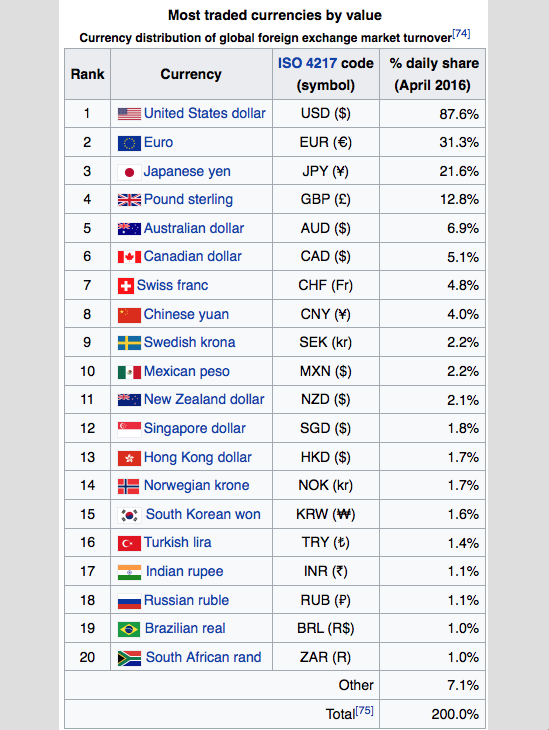
Note − The world’s three most common currency transactions are exchanges between the Dollar and the Euro (30%), the Dollar and the Yen (20%), and the Dollar and the Pound Sterling (12%).